Pitney Bowes Facility High Throughput Sortation
⭐Key Features
- •EuroSort Single Split Tray Sorter (Bomb Bay type)
- •Designed to fit the maximum number of sortation destinations in a given area
- •High throughput capacity
Results & Benefits
- Eliminated manual touches in the sortation process
- Reduced sorting errors
- Reduced total square footage required for sortation operations
Challenges & Solutions
Needing to fit a high number of sortation destinations into a limited floor area while improving efficiency.
Selected the EuroSort Single Split Tray (Bomb Bay) Sorter, which is specifically designed to maximize destination count within a compact footprint, automating the process.
Project Overview
Project Overview
Pitney Bowes, a major player in shipping, mailing, and e-commerce technology, sought to enhance the efficiency and accuracy of its parcel sortation operations at one of its facilities. The goal was to modernize the sorting process to handle high volumes more effectively.
The primary business need was to implement an automated sortation solution that could maximize sorting capacity—specifically, the number of destination chutes—within the constraints of the existing or planned facility space. This would directly address issues related to manual handling, error rates, and the inefficient use of valuable floor space.
Technical Solution
EuroSort Single Split Tray Sorter (Bomb Bay)
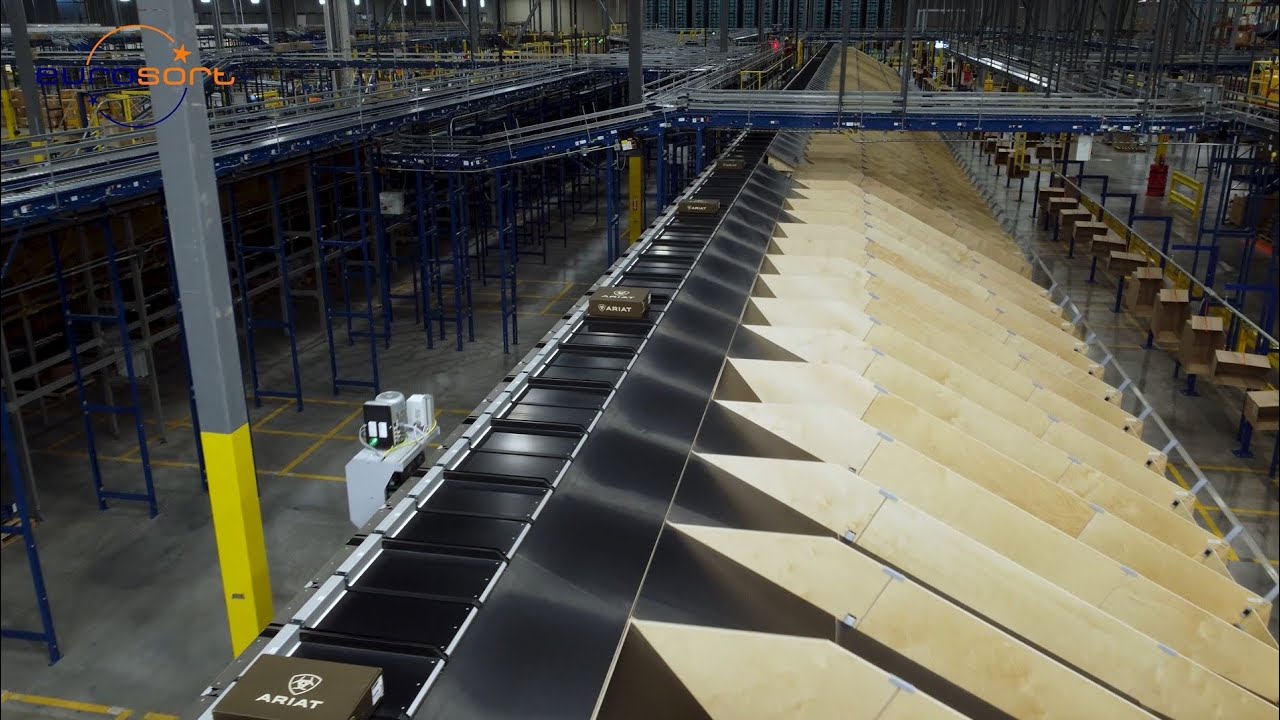
The selected solution is the EuroSort Single Split Tray Sorter, also known as a Bomb-Bay sorter. This type of sorter features trays that split open at the bottom to drop items directly down into the designated destination chute or container below. This design is key to its space efficiency.
Split Tray (Bomb Bay) Sorter Compilation: Versatile High-Speed Sortation
Vendor: Others
Key Features
The defining feature of this sorter is its space-optimized design. The split-tray/bomb-bay mechanism allows for an exceptionally dense array of sort destinations directly beneath the sorter loop, enabling Pitney Bowes to achieve a high sortation capacity without requiring a large building footprint.
The system is engineered for high-speed operation, capable of processing a large volume of parcels per hour, which is essential for the throughput demands of a major logistics provider like Pitney Bowes.
Results & Benefits
By automating the sortation process, the system eliminated numerous manual handlings (touches) previously required to move items to their correct destinations, reducing labor requirements and physical strain.
Automated sorting based on barcode scanning significantly increased accuracy compared to manual methods, leading to fewer mis-sorted parcels and associated costs or delays.
The efficient design of the EuroSort sorter allowed Pitney Bowes to achieve its required sorting capacity in less floor space than alternative systems might have required, leading to potential savings on facility costs.
Challenges & Solutions
The operational challenge was achieving a high sortation capacity with many destination lanes within a limited or optimally used facility area. Pitney Bowes addressed this by selecting the EuroSort Single Split Tray Sorter. This technology's bomb-bay design was the ideal solution because it allows for the densest possible packing of destination chutes directly beneath the sorter, maximizing the number of destinations per square foot of floor space and enabling efficient automation within the spatial constraints.
System Integrator
EuroSort was the system integrator for this project. They supplied and installed the Single Split Tray (Bomb Bay) Sorter at the Pitney Bowes facility. EuroSort's technology was chosen specifically for its ability to meet Pitney Bowes' key requirement of fitting the maximum number of sort destinations into the available area.
Related Technologies (6)
Split Tray (Bomb Bay) Sorter Compilation: Versatile High-Speed Sortation
byOthers
Dual Split Tray (Bomb Bay) Sorter for Apparel E-Commerce
byOthers
Dual Split Tray Sorter: Over-Under Apparel Store Replenishment
byEuroSort
Dual Split Tray (Bomb Bay) Sorter: High-Speed Apparel Sortation
byEuroSort
Sorting Technology Demonstration and Testing
byEuroSort
Patented Dual Split Tray (Bomb Bay) Sorter with Batch Induction
byOthers
Related Knowledge Articles (5)
Bomb-Bay Sorter
Bomb-Bay Sorters use gravity-fed drop mechanisms where packages travel on carriers with bottom doors that open to release items into chutes below. Ideal for high-speed parcel operations, these systems excel at handling uniform packages with exceptional throughput rates while maintaining gentle handling through controlled gravity discharge.
Cross-Belt Sorter
Cross-Belt Sorters are high-speed automated sorting systems that use individual carrier vehicles with miniature conveyor belts to gently divert packages to their designated destinations. These systems excel at handling diverse package types with exceptional accuracy and throughput, making them ideal for e-commerce, parcel, and distribution operations.
Tilt-Tray Sorter
Tilt-Tray Sorters are high-speed automated sorting systems featuring individual tilting trays mounted on a continuous loop that discharge items by tilting at precise moments. Known for their exceptional speed and reliability, these systems are ideal for handling small to medium-sized items in high-volume parcel, postal, and e-commerce operations.
Sorting Robot
Sorting Robots use mobile autonomous robots equipped with intelligent vision systems and manipulation capabilities to sort packages, parcels, and items with exceptional flexibility. These systems combine AMR technology with advanced AI to enable dynamic sortation without fixed infrastructure, adapting to changing operational needs and handling diverse item types with human-like dexterity.
Sliding Shoe Sorter
Sliding Shoe Sorters use rows of sliding diverter shoes mounted on a conveyor belt to gently push items onto discharge lanes at precise angles. Known for their gentle handling and ability to sort at high speeds, these systems excel at handling cases, cartons, and totes in distribution and fulfillment operations.