The independent database for warehouse automation
Compare AGVs and AMRs, AS/RS systems, vertical lift modules, and WMS software across real deployments — curated by operators, for operators.
Covering the industry's leading automation companies













What is warehouse automation, and where do I start?
Warehouse automation combines software, robotics, and material handling equipment to move, store, and process inventory with minimal manual intervention. A typical deployment stacks a Warehouse Management System on top of physical automation — AMRs and AGVs, AS/RS, shuttles, and vertical lift modules, goods-to-person workstations, conveyors, and robotic picking arms.
The question is no longer whether to automate — it's what to automate, in what order, and with which suppliers. Decisions increasingly turn on ROI timelines, WMS integration, and total cost of ownership across a 5-10 year horizon.
Warehouse Tech Navigator maps this landscape through verified deployments, technology deep-dives, vendor-neutral comparisons, and detailed implementation guides — so you can benchmark, shortlist, and plan with confidence.
Compare warehouse automation technologies
Before you invest, understand the tradeoffs. Side-by-side breakdowns of the most-asked automation comparisons.
AGV vs AMR
AGVs follow fixed paths; AMRs navigate dynamically with LiDAR and SLAM. Compare cost, flexibility, and deployment speed to decide which fits your warehouse.
AutoStore vs Shuttle
AutoStore maximizes density with cube-style storage; shuttle systems deliver higher throughput per aisle. Understand when each architecture wins.
WMS vs WES vs WCS
WMS plans the work, WES orchestrates execution across automation, WCS controls hardware. Learn where each layer sits and when you need all three.
Goods-to-Person vs Person-to-Goods
GTP stations bring inventory to pickers for 3-5x productivity; person-to-goods uses labor walking the aisles. Compare productivity, cost, and scalability.
Vertical Lift Modules (VLMs): compress your warehouse vertically
A vertical lift module is an enclosed, automated storage system that uses an inserter/extractor to bring trays of inventory from high-density shelving directly to an ergonomic pick window. VLMs are one of the fastest-growing categories in material handling — they reclaim vertical airspace, eliminate the walking time that dominates manual picking, and deliver reliable, accurate fulfillment for slow and medium movers.
Fresh from the warehouse automation industry
Curated daily from global sources so you never miss a deployment or launch.
Separate English-language posts over the same window discussed humanoid and cobot warehouse work rat
Separate English-language posts over the same window discussed humanoid and cobot warehouse work rather than classic AGVs. One noted Agility’s Digit moving more than 100,000 totes in a live warehouse with people present, framing that as a shift from demo videos to production tote handling. Another p...
Read storyOn X, Auddomate published a product-style update describing a machine library for warehouse layout a
On X, Auddomate published a product-style update describing a machine library for warehouse layout and automation feasibility work. The library covers twenty-nine equipment classes including counterbalance and reach trucks, VNA, pallet movers, tow tractors, AMRs, and AGVs, each with speed, width, le...
Read story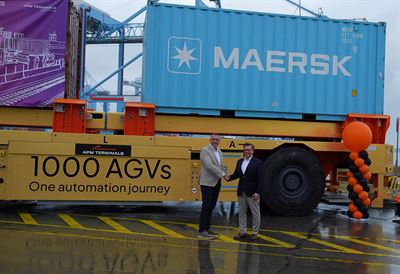
Konecranes and APM Terminals Maasvlakte II marked handover of Konecranes’ 1,000th automated guided v
Konecranes and APM Terminals Maasvlakte II marked handover of Konecranes’ 1,000th automated guided vehicle at the Rotterdam terminal. The milestone AGV is presented as the product of more than a decade of joint work on automated container moves between quay and yard. In this setting AGVs are electri...
Read storyTrends shaping warehouse automation in 2026
The topics operations leaders, supply chain strategists, and IT teams research most — with links to curated content on each.
AI-driven warehousing
Machine learning for slotting, forecasting, and orchestration. Real deployments of AI WMS, computer vision picking, and agentic planning.
Collaborative robots (cobots)
Safe human-robot picking, palletizing cobots, and humanoid robots entering fulfillment operations in 2026.
Cold chain & frozen automation
Freezer-rated AS/RS, cryo-compatible AMRs, and automated storage designed for -25°C grocery and pharma distribution.
Omnichannel fulfillment
Unified inventory, store fulfillment, and parcel-ready automation for retailers balancing e-commerce and brick-and-mortar.
Vertical Lift Modules (VLMs)
High-density automated storage for slow and medium movers. 85% space savings with 150-300 line/hr pick rates.
Sustainability & energy
Regenerative braking AS/RS, off-peak charging AMR fleets, and LEED-friendly automation reducing kWh per order shipped.
Popular automation categories
Explore solutions by technology type, from autonomous mobile robots and AS/RS cranes to WMS platforms and high-throughput sortation.
AGV & AMR Systems
Compare Automated Guided Vehicles with Autonomous Mobile Robots. Explore LiDAR navigation, SLAM mapping, fleet orchestration, and payback timelines for path-based and dynamic robots.
Learn moreWMS, WES & WCS Software
Understand warehouse management, execution, and control layers. WMS implementation guides, WES orchestration patterns, cloud vs on-premise, and integration with ERP platforms.
Learn moreConveyor & Sortation
Belt, roller, overhead, and high-speed conveyor automation paired with cross-belt, tilt-tray, and sliding-shoe sorters. Match throughput class to parcel, 3PL, grocery, or returns.
Learn moreAS/RS & VLM Storage
Unit-load AS/RS cranes, mini-load and shuttle systems, vertical lift modules (VLMs), and goods-to-person cube-storage. Compare density, throughput, and ROI across footprints.
Learn morePicking Systems
Goods-to-person workstations, pick-to-light, voice picking, RF scanning, and robotic piece-picking with AI vision. Match pick strategy to e-commerce, case picking, or MRO.
Learn moreSortation Systems
Cross-belt, tilt-tray, sliding-shoe sorters, and robotic sortation arms. Compare accuracy, induction rates, and gentle-handling options for parcels, apparel, and returns.
Learn moreProfessional implementation guides
Comprehensive e-books covering warehouse automation from planning to go-live — WMS selection frameworks, ROI modeling, and cold-chain deployment playbooks.
Warehouse Automation System Integration
A comprehensive technical guide to integrating automated warehouse systems. Covers integration architecture, WMS/WCS/WES connectivity, AGV/AMR fleet integration, interface design, testing, and real-world case studies across e-commerce, 3PL, and manufacturing environments.
AGV/AMR Implementation Guide
Master the complete process of implementing AGV and AMR systems in your warehouse. From initial assessment to full deployment, this guide covers technology selection, integration strategies, safety protocols, and ROI optimization.
Warehouse automation, explained
Quick answers to the questions operations leaders ask before starting an automation project.
What is warehouse automation?
Warehouse automation is the use of software, robotics, and material handling equipment to move, store, and process inventory with minimal human intervention. Common systems include Automated Guided Vehicles (AGVs), Autonomous Mobile Robots (AMRs), Automated Storage and Retrieval Systems (AS/RS), vertical lift modules (VLMs), conveyor and sortation equipment, goods-to-person solutions, and a Warehouse Management System (WMS) that orchestrates the operation.
AGV vs AMR: what is the difference?
AGVs follow fixed paths defined by magnetic tape, wires, or reflective markers, and stop when obstructed. AMRs use onboard sensors, LiDAR, and SLAM software to navigate dynamically, build maps of the facility, and plan routes around obstacles. AMRs are generally faster to deploy, easier to reconfigure, and better suited to mixed human-robot environments. AGVs still win on cost for simple, repetitive transport tasks in stable layouts with long payback windows.
What is a vertical lift module (VLM) and when should I use one?
A vertical lift module is an enclosed automated storage system that uses an inserter/extractor to retrieve trays of inventory from high-density shelving and deliver them to an ergonomic pick window. VLMs compress up to 85% of floor space compared to static shelving, reach picking rates of 150-300 lines per hour, and shine for slow and medium movers in assembly kitting, MRO spare parts, e-commerce replenishment, and pharmacy distribution. They are ideal when ceiling height exceeds 6 meters and SKU counts are high but order volumes are moderate.
How do I calculate ROI for a warehouse automation project?
Warehouse automation ROI is driven by labor savings, throughput gains, inventory accuracy, and space density. A typical calculation compares annual labor reduction (hourly rate × hours saved × number of shifts), throughput improvement (orders per hour × margin per order), inventory write-off reduction, and facility cost avoidance against capital cost plus 5-10 years of maintenance and software fees. Well-executed AMR and goods-to-person projects commonly hit payback in 18-36 months. AS/RS and AutoStore payback typically ranges 3-6 years depending on site density and throughput.
What is the difference between WMS, WES, and WCS?
A Warehouse Management System (WMS) manages inventory and order flow at the business process level: receiving, put-away, picking strategy, wave planning, and shipping. A Warehouse Execution System (WES) coordinates real-time task allocation across multiple automated subsystems, dynamically balancing throughput. A Warehouse Control System (WCS) directly controls hardware like conveyors, sorters, and AS/RS cranes. Modern orchestration platforms increasingly blend WMS, WES, and even WCS functions into a single software layer.
How should I plan a WMS implementation?
A WMS implementation typically runs 6-18 months and follows five phases: requirements and fit analysis, solution design and integration mapping, configuration and data migration, user acceptance testing, and phased go-live. Critical success factors include clean master data, executive sponsorship, dedicated super-users, realistic cutover planning, and a contingency plan for day-one operations. Budget 1.5-2x the software license cost for integration, training, and change management.
Which industries benefit most from warehouse automation?
High-volume e-commerce fulfillment centers, 3PLs, cold-chain grocery, pharmaceutical distribution, apparel omnichannel, and automotive parts distribution see the strongest automation ROI. The common thread is SKU variety with predictable order velocity, tight service-level commitments, and rising labor cost. Manufacturing kitting, aerospace spare parts, and medical device distribution are also growing automation segments in 2026.
How does automation work for cold chain and frozen warehouses?
Cold-chain warehouse automation uses freezer-rated AS/RS cranes, cryo-compatible shuttles, and AGVs engineered for -25°C operation. Key advantages include reducing human exposure to extreme temperatures, minimizing door-open time to preserve temperature stability, and maintaining FIFO accuracy for perishables. Common deployments include automated deep-freeze storage for ice cream and seafood, chilled goods-to-person pick stations for grocery e-commerce, and robotic palletizing in food production.
What automation fits 3PL warehouses best?
Third-party logistics providers favor flexible, scalable automation that can handle changing client mixes: AMR fleets with swappable top modules, modular goods-to-person systems, and cloud-based WMS that supports multi-client billing. Robotics-as-a-Service (RaaS) contracts let 3PLs scale capacity to seasonal peaks without fixed capital. Key selection criteria are fast onboarding for new clients, flexibility for varying SKU profiles, and integration with multiple customer ERP or OMS platforms.
How do I choose a warehouse automation supplier?
Start with a clear operational problem statement (orders/hour, SKU count, peak volumes, building constraints), then evaluate suppliers on reference installations in your industry, system integrator ecosystem, WMS/WES openness, and post-go-live support. Ask for a phased pilot before committing to full scale, and request documented uptime, spare parts SLA, and software update policy. Browse supplier profiles and project case studies on this site to shortlist vendors.
What is goods-to-person (GTP) fulfillment?
Goods-to-person (GTP) is a picking strategy where automated storage systems bring inventory bins or totes directly to stationary pick stations, eliminating the walking time that dominates traditional picker-to-goods operations. AutoStore, shuttle systems, and AMR-based bin delivery are the most common GTP architectures. GTP typically delivers 3-5x productivity gains and fits e-commerce single-item picking better than case-level fulfillment.
AutoStore vs shuttle system: which one should I choose?
AutoStore excels at very high storage density, reliability through redundant robots, and incremental scale-up for small-to-medium SKU sizes. Shuttle systems (tote or case) deliver higher per-aisle throughput, accommodate heavier and larger loads, and support deeper buffer storage for waves or batches. Choose AutoStore for maximum cube utilization in a fixed footprint with a wide SKU range; choose shuttles for high-throughput order fulfillment with larger cases or higher pick rates per aisle.
Ready to automate your warehouse?
Start with real deployments, compare vendor-neutral technologies, and connect with the integrators who have done it before.