Sliding Shoe Sorter
Sliding Shoe Sorters use rows of sliding diverter shoes mounted on a conveyor belt to gently push items onto discharge lanes at precise angles. Known for their gentle handling and ability to sort at high speeds, these systems excel at handling cases, cartons, and totes in distribution and fulfillment operations.
Sliding Shoe Sorter System Architecture
System Components
- ▸Conveyor: 30-150m length typical
- ▸Shoes: Sliding diverter rows
- ▸Actuators: Pneumatic/electromagnetic
- ▸Scanners: Barcode & dimensioning
Performance
- ▸Throughput: 8,000-20,000 items/hr
- ▸Accuracy: 99.9%+ sort rate
- ▸Speed: 150-400 ft/min
- ▸Destinations: 20-100 lanes
Item Handling
- ▸Weight: 0.5-50 kg (up to 75 kg)
- ▸Size: 150mm to 1200mm
- ▸Types: Cases, cartons, totes
- ▸Divert: 15-30° gentle push
Key Applications
- ▸Distribution: Case-level sorting
- ▸E-commerce: Order consolidation
- ▸Manufacturing: WIP & finished goods
- ▸Fulfillment: Wave picking consolidation
Induction Methods
- ▸Manual: 800-1,200 items/hr/station
- ▸Automated: Singulation & merge
- ▸Hybrid: Flexible approach
- ▸Orientation: Alignment systems
Investment & ROI
- ▸Cost: $800K-$4M installed
- ▸Payback: 2-4 years typical
- ▸Labor: 50-70% reduction
- ▸Threshold: 5K+ items/day
System Overview and Operating Principles
The sliding shoe sorter represents an elegant solution to one of distribution's fundamental challenges: how to divert items from a high-speed conveyor flow into multiple destinations without damaging products or disrupting throughput. Imagine a conveyor belt surface covered with rows of small plastic or metal "shoes" that normally travel straight ahead with the belt. When an item needs to be diverted, a precisely timed mechanism causes a row of these shoes to slide diagonally across the belt surface, gently pushing the item at an angle onto a discharge lane. This positive diversion approach—where shoes actively push items rather than relying on gravity or impact—makes sliding shoe sorters particularly well-suited for handling cases, cartons, and totes that require controlled, gentle handling.
The mechanical elegance of sliding shoe technology lies in its simplicity and reliability. Each shoe is mounted on a small carriage that rides in a track beneath the conveyor belt surface, allowing it to slide laterally when activated. The activation mechanism typically uses pneumatic cylinders or electromagnetic actuators positioned along the sorter length at each divert point. When the control system determines an item should be diverted, it triggers the actuator at precisely the right moment, causing a row of shoes to slide across the belt and push the item onto the discharge lane at a 15 to 30-degree angle. The shoes then automatically return to their home position, ready for the next divert. This cycle happens hundreds of times per hour with remarkable consistency and minimal wear.
System capacity and flexibility make sliding shoe sorters attractive for a wide range of applications. The technology handles items weighing from 0.5 to 50 kilograms, with some heavy-duty configurations extending to 75 kg. Item dimensions typically range from small cartons measuring 150mm x 150mm up to large cases or totes measuring 800mm x 1200mm. The conveyor width usually spans 600 to 1200mm, accommodating most standard case and tote sizes used in distribution operations. Belt speeds typically run 150 to 400 feet per minute, with the optimal speed depending on item characteristics, divert angle, and required throughput. This combination of speed and gentle handling makes sliding shoe sorters ideal for operations where product protection matters as much as processing speed.
Performance and Throughput Capabilities
Performance metrics for sliding shoe sorters demonstrate their capability to handle demanding distribution requirements. Modern systems routinely achieve sorting rates of 8,000 to 20,000 items per hour, with some high-performance installations reaching 25,000 items per hour when handling smaller, lighter items. The sort accuracy typically exceeds 99.9%, meaning fewer than one item per thousand is missorted—a level of precision essential for maintaining order accuracy and customer satisfaction. This accuracy stems from sophisticated barcode scanning and dimensioning systems that identify and measure each item as it enters the sorter, combined with precise timing controls that trigger shoe activation at exactly the right moment.
The gentle diversion characteristic of sliding shoe technology delivers significant value in operations handling products sensitive to impact or jarring. Unlike systems that use pusher arms or deflectors that can impart sudden forces, sliding shoes gradually accelerate items onto discharge lanes, reducing the risk of product damage or package shifting. This gentle handling proves particularly valuable for operations sorting fragile items, stacked products, or loosely packed cartons where rough handling could cause damage or require repackaging. The controlled diversion also enables higher belt speeds than some alternative technologies, as items don't need to slow down significantly before being diverted.
Bastian Solutions Corporate Profile: Toyota Advanced Logistics
System Integrator: Bastian Solutions
Economic Considerations and ROI
Investment in sliding shoe sortation requires careful financial analysis, with typical system costs ranging from $800,000 to $4 million depending on length, throughput capacity, number of destinations, and level of automation. A mid-sized installation serving a regional distribution center might cost $1.5 to $2.5 million including equipment, installation, controls, and integration with existing warehouse systems. While substantial, these costs often deliver return on investment within 2 to 4 years for operations processing more than 5,000 cases daily, driven primarily by labor savings and throughput improvements.
Labor cost reduction represents the primary economic driver for most implementations. By automating the sorting process, sliding shoe systems can reduce direct sorting labor by 50 to 70% while simultaneously increasing throughput capacity and improving accuracy. For a facility processing 15,000 cases per day, annual labor savings of $250,000 to $500,000 are common, providing a clear path to payback even accounting for maintenance costs and system depreciation. Beyond direct labor savings, the system delivers improved accuracy that reduces costly shipping errors and returns, faster processing that enables tighter delivery windows, and operational consistency that simplifies workforce planning and reduces dependence on temporary labor during peak periods.
System Integration and Control
Successful sliding shoe operation depends on seamless integration between multiple system layers working in concert. The warehouse management system (WMS) provides high-level sorting logic, determining destination assignments based on order data, customer locations, carrier routes, and delivery schedules. The warehouse control system (WCS) translates these instructions into precise mechanical commands, managing conveyor speeds, tracking item positions, and coordinating shoe activation timing with microsecond precision. Modern systems employ predictive algorithms that optimize throughput by anticipating item arrivals and adjusting belt speeds to maintain optimal spacing between items.
Real-time tracking forms the foundation of system intelligence. As items enter the sorter, barcode scanners capture identification data and communicate it to the WCS, which immediately calculates the optimal divert point based on current item position and destination requirements. Dimensioning systems using laser or camera technology measure item length, width, and height, ensuring the system activates enough shoes to fully support and divert each item regardless of size. This level of control enables dynamic routing that can adapt to changing priorities, such as expediting urgent orders or rerouting items when specific destinations become full or unavailable.
Sorting Technology Demonstration and Testing
Vendor: EuroSort
Facility Requirements and Infrastructure
Physical infrastructure requirements deserve careful attention during planning phases. Sliding shoe sorters typically require minimal elevation compared to tilt-tray or cross-belt systems, as items discharge onto lanes at the same level as the main conveyor. This floor-level design simplifies facility integration and reduces structural requirements, though adequate space must be allocated for discharge lanes and downstream processing. The floor space requirement depends on sorter length and destination count, but a typical installation might occupy 1,000 to 3,000 square meters including discharge lanes and buffer areas.
Conveyor length significantly influences system capacity and cost. Longer sorters accommodate more divert points and thus more destinations, but also require more floor space and higher investment. Typical installations range from 30 to 150 meters in length, with the optimal length determined by the number of destinations required, available floor space, and throughput targets. The sorter can be configured in straight-line, curved, or serpentine layouts to fit specific building constraints and operational requirements. Some operations employ multiple shorter sorters rather than one long system, providing operational flexibility and redundancy at the cost of additional complexity.
Induction Methods and Package Flow
The induction process—how items enter the sorter—significantly influences overall system performance and represents a critical design decision. Manual induction involves operators placing items onto the conveyor, with the system controlling belt speed to maintain proper spacing. This approach offers maximum flexibility for handling irregular items and provides a quality control checkpoint, but limits throughput to what humans can sustain, typically 800 to 1,200 items per hour per induction station. Most manual induction systems employ ergonomic workstations with adjustable heights and clear visual indicators showing proper placement, reducing operator fatigue and improving accuracy.
Automated induction uses upstream conveyors, singulation systems, and gap creation mechanisms to feed items onto the sorter at optimal spacing and orientation. Automated systems excel with standardized items that meet specific size and weight criteria, delivering consistent performance without the variability of human operators. Merge conveyors combine multiple induction lanes into a single sorter feed, maximizing throughput while maintaining proper item spacing. Orientation systems using sensors and diverters ensure items enter the sorter in the correct alignment for successful diversion. Many operations employ a hybrid approach, using automated induction for the bulk of standard items while maintaining manual stations for oversized, irregular, or special-handling items.
Maintenance and Operational Support
Preventive maintenance programs are essential for maintaining sliding shoe system performance and reliability. Daily routines typically include visual inspections of shoes, belt surface, and divert mechanisms, checking for any signs of wear or damage that could affect operation. Weekly maintenance involves lubrication of shoe carriages and actuators, cleaning of sensors and scanners, and verification of shoe alignment and divert angles. Monthly service includes detailed inspections of drive systems, replacement of worn shoes, and calibration of timing controls. Quarterly comprehensive service addresses major components like drive motors, pneumatic systems, and control electronics, ensuring long-term reliability.
The modular nature of sliding shoe systems facilitates maintenance activities. Individual shoes can be replaced quickly without shutting down the entire system, though operations typically schedule such work during lower-volume periods to minimize impact. Most operators maintain a spare parts inventory including replacement shoes, actuators, sensors, and drive components to enable rapid response to failures. Leading equipment suppliers offer service contracts that include remote monitoring, predictive maintenance alerts based on system data, and guaranteed response times, providing operational peace of mind for facilities where sorter downtime directly impacts customer service commitments.
Industry Applications and Use Cases
Distribution centers represent the primary application for sliding shoe sorters, where cases and cartons must be quickly sorted to shipping lanes, packing stations, or storage locations. The system's ability to handle the size and weight range typical of case-level distribution—from small cartons to large cases—makes it well-suited for this application. The gentle handling protects product integrity while maintaining high throughput, enabling distribution centers to process thousands of cases per hour without damage or delays. Some operations use sliding shoe sorters for wave picking consolidation, where cases picked for multiple orders are sorted to packing stations organized by customer or delivery route.
E-commerce fulfillment operations increasingly deploy sliding shoe sorters for case-level sorting and order consolidation. After items are picked and packed into shipping cartons, the sorter directs them to shipping lanes organized by carrier, service level, or destination zone. This application leverages the sorter's ability to handle diverse carton sizes while maintaining high throughput, enabling fulfillment centers to process thousands of orders per hour. The accuracy of sliding shoe sorting reduces costly shipping errors, while the speed supports aggressive delivery commitments like same-day or next-day service. The gentle handling also reduces damage during the sorting process, improving customer satisfaction and reducing returns.
Manufacturing operations use sliding shoe sorters for work-in-process sorting and finished goods distribution. In automotive parts manufacturing, for example, sorters direct cases of components to different assembly lines or storage locations based on production schedules and inventory requirements. In food and beverage operations, sorters direct cases of finished products to different palletizing stations organized by SKU, customer, or shipping destination. The reliability and gentle handling of sliding shoe technology make it particularly suitable for these applications where product protection and operational consistency are critical.
Technology Variants and Configurations
Standard sliding shoe systems feature shoes that divert to one side only, discharging items to lanes positioned along one side of the conveyor. This configuration maximizes simplicity and reliability, making it ideal for operations with moderate destination counts and straightforward layouts. Bi-directional sliding shoe systems can divert to either side, effectively doubling the number of destinations accessible from a given conveyor length. While more complex and expensive, bi-directional systems provide valuable flexibility for operations with high destination counts or space constraints that make single-sided discharge impractical.
Shoe spacing variations accommodate different operational requirements. Dense shoe configurations with shoes spaced every 3 to 4 inches provide maximum support for small items and enable diversion of closely spaced packages, optimizing throughput for operations handling predominantly small cartons. Wide shoe spacing with shoes every 6 to 8 inches reduces system cost and complexity while still providing adequate support for larger, heavier items. Some systems employ variable shoe spacing along the sorter length, using dense spacing near induction points where items are closely spaced and wider spacing downstream where items have naturally separated, optimizing both performance and cost.
Future Trends and Technology Evolution
Artificial intelligence and machine learning are beginning to enhance sliding shoe system capabilities. Predictive algorithms analyze historical data to optimize divert timing, accounting for item characteristics like size, weight, and surface friction that affect diversion behavior. Computer vision systems supplement traditional barcode scanning, enabling identification and measurement of items even when labels are damaged, missing, or poorly positioned. Some advanced systems use AI to detect item characteristics and automatically adjust divert parameters, ensuring successful diversion across a wider range of package types without manual intervention.
Energy efficiency improvements continue to reduce operational costs. Modern systems incorporate variable frequency drives that adjust motor speeds based on actual load requirements rather than running at constant maximum capacity, reducing energy consumption during lower-volume periods. Efficient pneumatic systems with optimized valve designs and pressure regulation minimize compressed air consumption, a significant cost factor in pneumatic-actuated sorters. LED lighting with motion sensors and smart climate control in sorter areas contribute additional savings, making newer installations significantly more sustainable than older systems.
Modular design approaches are making sliding shoe systems more accessible and adaptable. Standardized components and plug-and-play interfaces reduce installation time and complexity, while enabling easier expansion as business grows. Some manufacturers offer pre-configured sorter modules in standard lengths that can be combined to create custom system sizes, reducing engineering time and cost. This modularity also facilitates phased implementation, allowing operations to start with a smaller system and expand incrementally as volumes justify additional capacity, reducing initial investment risk while providing a clear growth path.
Implementation Considerations and Decision Criteria
Selecting sliding shoe sortation requires careful analysis of operational requirements and item characteristics. The technology excels with items that have flat, stable bottoms and reasonably regular shapes—typically cases, cartons, and totes used in distribution operations. Items with irregular shapes, very small footprints, or unstable bases may not divert reliably and might require alternative sortation technologies. The volume threshold for justifying sliding shoe investment typically falls around 5,000 to 8,000 items per day, though this varies based on labor costs, accuracy requirements, and growth projections.
Destination count significantly influences system design and cost. Each sort destination requires a discharge lane and downstream processing capability, with typical systems accommodating 20 to 100 destinations depending on sorter length and configuration. Operations requiring more destinations might need multiple sorter passes, bi-directional diversion, or alternative technologies. The physical layout of destination points affects system efficiency—ideally, high-volume destinations should be positioned for easy access and efficient downstream processing. Some operations employ dynamic destination assignment, where the same physical lane serves different logical destinations at different times, maximizing flexibility while controlling infrastructure costs.
Integration complexity deserves careful attention. Successful sliding shoe implementation requires seamless coordination between the sorter, upstream processes like receiving and induction, downstream activities like palletizing and shipping, and overarching systems like WMS and transportation management. The project timeline typically spans 10 to 16 months from initial planning through full operational deployment, including design, equipment procurement, installation, testing, and ramp-up. Organizations should plan for change management activities including operator training, process documentation, and performance monitoring to ensure smooth transition from manual to automated sorting.
Success with sliding shoe sorters demands more than equipment installation—it requires commitment to operational excellence, continuous improvement, and system optimization. The most successful implementations treat the sorter as part of an integrated operation rather than a standalone solution, ensuring that all elements of the sorting process work together harmoniously. When properly planned, implemented, and maintained, sliding shoe sorters deliver decades of reliable service, processing millions of cases annually with the speed, accuracy, and gentle handling that modern distribution operations demand.
Related Technologies (6)
ZiPsort Shoe Sorter: High-Throughput All-Electric Sortation Solution
Bastian Solutions
Sliding Shoe Sorter: High-Capacity, Versatile Sortation
Others
Sliding Shoe Sorter: High-Speed and Gentle Sortation Solution
Others
HDS Sliding Shoe Sorter: High-Speed Versatile Sortation
Honeywell Intelligrated
Intralogistics Innovation Center: Integrated Solutions Showcase
Daifuku
Sorting Technology Demonstration and Testing
EuroSort
Related Sortation Topics
Bomb-Bay Sorter
Bomb-Bay Sorters use gravity-fed drop mechanisms where packages travel on carriers with bottom doors that open to release items into chutes below. Ideal for high-speed parcel operations, these systems excel at handling uniform packages with exceptional throughput rates while maintaining gentle handling through controlled gravity discharge.
Cross-Belt Sorter
Cross-Belt Sorters are high-speed automated sorting systems that use individual carrier vehicles with miniature conveyor belts to gently divert packages to their designated destinations. These systems excel at handling diverse package types with exceptional accuracy and throughput, making them ideal for e-commerce, parcel, and distribution operations.
Pouch/Pocket Sorter
Pouch Sorters use suspended fabric pouches or pockets traveling on an overhead track to sort individual items with exceptional gentleness and flexibility. Ideal for fashion, apparel, and omnichannel retail operations, these systems excel at handling soft goods, hanging garments, and irregularly shaped items while providing dynamic buffering and sequencing capabilities.
Tilt-Tray Sorter
Tilt-Tray Sorters are high-speed automated sorting systems featuring individual tilting trays mounted on a continuous loop that discharge items by tilting at precise moments. Known for their exceptional speed and reliability, these systems are ideal for handling small to medium-sized items in high-volume parcel, postal, and e-commerce operations.
About This Topic
Related Projects(6)
Amway Midwest Regional Service Center, Ada
Bastian Solutions
Lao Gan Ma Guiyang Guizhou Production Warehouse
Daifuku
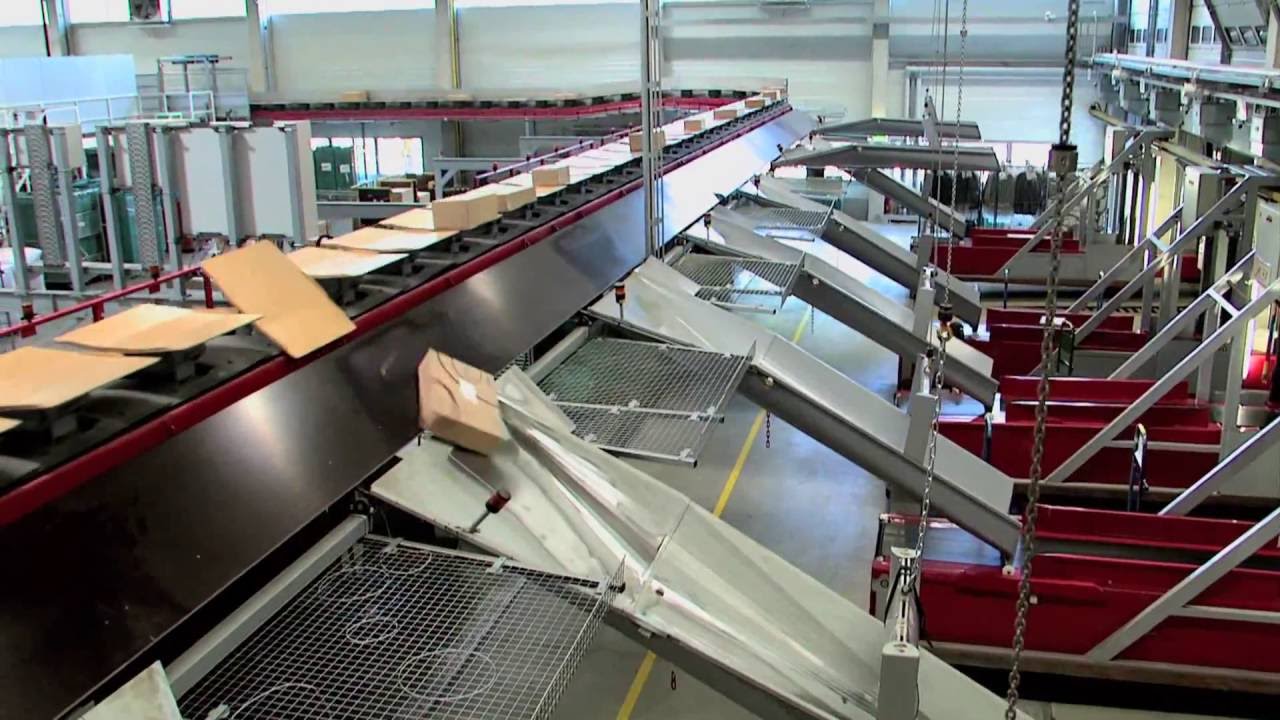
Witt-Gruppe Weiden Distribution Center
Beumer Group
GLS Spain Madrid Parcel Sorting Hub
Körber
Bastian Solutions Corporate Profile: Toyota Advanced Logistics
Bastian Solutions

Bee Sweet Citrus California Palletizing Facility
Honeywell Intelligrated


