The 2026 Automation Study from Peerless Research Group, published by Modern Materials Handling on July 31, 2026, provides a detailed snapshot of warehouse and distribution center automation adoption based on responses from more than 120 professionals directly involved in purchasing decisions. Global investment in warehouse automation reached approximately $21 billion in 2023 and is projected to exceed $90 billion by 2033, representing a 329% increase over the decade. Key drivers include the continued e-commerce expansion, persistent labor shortages, and the ongoing need to reduce costs while improving operational efficiency.
Respondents represent a broad range of industries, including food, beverage and tobacco (15%), electrical equipment (8%), chemicals and pharmaceuticals (7%), and aerospace (7%). Nearly half work inside warehouses or DCs, with facility sizes averaging 137,054 square feet; more than one-third operate sites larger than 250,000 square feet. Average facility employment stands at 1,095 people, and average company revenue is $675 million.
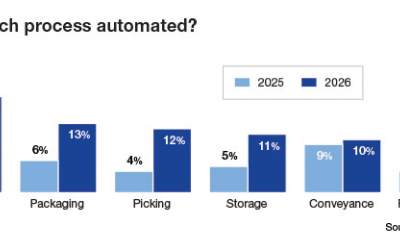
Full automation levels remain modest across core processes: labeling leads at 24%, followed by reporting (18%) and packaging (13%). Picking is fully automated at only 12%, storage at 11%, conveyance at 10%, replenishment at 9%, and retrieval at just 3%. Significant shares of operations remain mostly or fully manual with no automation plans—33% for picking, 31% for retrieval, and 30% each for storage and packaging.
Partial automation is more common, with 38% reporting partially automated conveyance and 35% for replenishment and retrieval. Equipment adoption shows stronger momentum. Forty-nine percent currently use conveyor and sortation systems, with 51% planning implementations or upgrades within two years.
Goods-to-person picking solutions are in use at 48% of facilities, also with 51% planning expansions. Weighing, cubing and dimensioning equipment is used by 43% (57% planning upgrades), pocket sortation by 41% (59% planning improvements), automated packaging by 37%, automated storage systems (mini-loads and AS/RS) by 36%, AGVs by 35%, and palletizing robotics by 33%. When evaluating new systems, durability, reliability and uptime are rated very important by 92% of respondents.
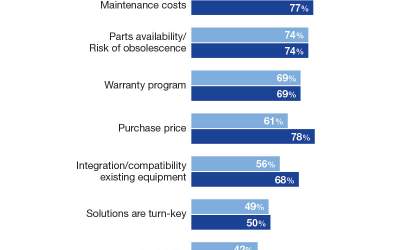
Fast service response times are essential for 95% (up from 83% the prior year). Purchase price is very important for 78%, total cost of ownership/ROI/maintenance for 77%, parts availability for 74%, warranty for 68%, integration/compatibility for 68%, and scalability for 59%. Primary investment drivers include meeting customer service-level agreements through faster order fulfillment, keeping pace with competitors, supporting new go-to-market strategies, and addressing labor recruitment and retention challenges.
Data-capture tools in use include mobile/wireless technologies (63%), barcode scanners (62%), RFID (47%), and light-based picking (42%). Software platforms center on WMS (57%), parcel rating tools (55%), labor management systems and computerized maintenance management systems (50% each), warehouse control systems (49%), TMS (43%), WES (38%), slotting software (36%), and YMS (30%). Planned focus areas over the next 24 months include YMS, slotting, WES and CMMS upgrades.
Average planned spending on materials handling equipment and solutions for 2026 is $1.6 million, up from $1.5 million in 2025. Spending distribution is wide: 29% plan less than $100,000, while 17% expect $1–2.49 million and 16% more than $5 million. Thirty-one percent anticipate increased spending, 43% expect levels to remain the same, and 22% remain uncertain.
Overall, the study indicates that automation momentum has shifted from intent to committed investment, with broad plans for equipment expansion even as many core processes remain largely manual.