Megatech Industries Deploys 4 MiR250 AMRs to Automate Internal Logistics in Automotive Plastics Manufacturing
⭐Key Features
- •4 MiR250 AMRs autonomously remove finished containers from production lines, transport them to the warehouse, and return empty containers — eliminating the need for forklift trips between production and warehouse
- •MiR fleet control integrated into Megatech's own software by MTS Tech, providing real-time location tracking, mission status, priority management, and incident resolution from a single interface
- •Safe, intuitive, and autonomous operation — accepted immediately by operators and described as 'just like any other robot in the plant'
- •Easy mission modification without major infrastructure changes — enabling flexible adaptation to changing production requirements
- •Ergonomic improvement for operators — reduced need to bend during packing, enabling a more upright working posture for longer periods
- •Operators freed from repetitive container transport to focus on higher-value warehouse logistics management tasks
- •Scalable deployment model — initial rollout at Amurrio plant serving as proof of concept for group-wide expansion
Results & Benefits
- Significant reduction in forklift-related incidents — robots replaced forklift trips for finished container removal and empty container replenishment, directly reducing the primary source of production floor incidents
- Significant reduction in production bottlenecks — instantaneous, efficient mission execution eliminated delays in container flow between production lines and warehouse
- Estimated annual ROI of approximately €100,000 — documented by Megatech as the financial return from the four-robot deployment at Amurrio
- Optimization of operator effort and reduction in labor costs — operators reassigned from repetitive transport tasks to warehouse logistics management
- Improved operator ergonomics — reduced bending during packing operations, enabling operators to maintain an upright posture for longer periods
- Strong operator acceptance — robots 'very well received by everyone,' with operators reporting missions as 'instantaneous and much more efficient'
- Expansion under evaluation — success at Amurrio driving consideration of deployment at Ourense (Spain) and Czech Republic facilities
Challenges & Solutions
Megatech's production lines required a continuous cycle of finished container removal and empty container replenishment to maintain uninterrupted production flow. This logistics cycle was previously performed by forklifts — a solution that introduced safety risks on a busy production floor shared with human operators, created bottlenecks when forklift availability did not match production demand, and imposed repetitive physical demands on operators who were required to manage packing in bent postures for extended periods. The forklift-based model was also inflexible: changing production layouts or task sequences required significant operational adjustments
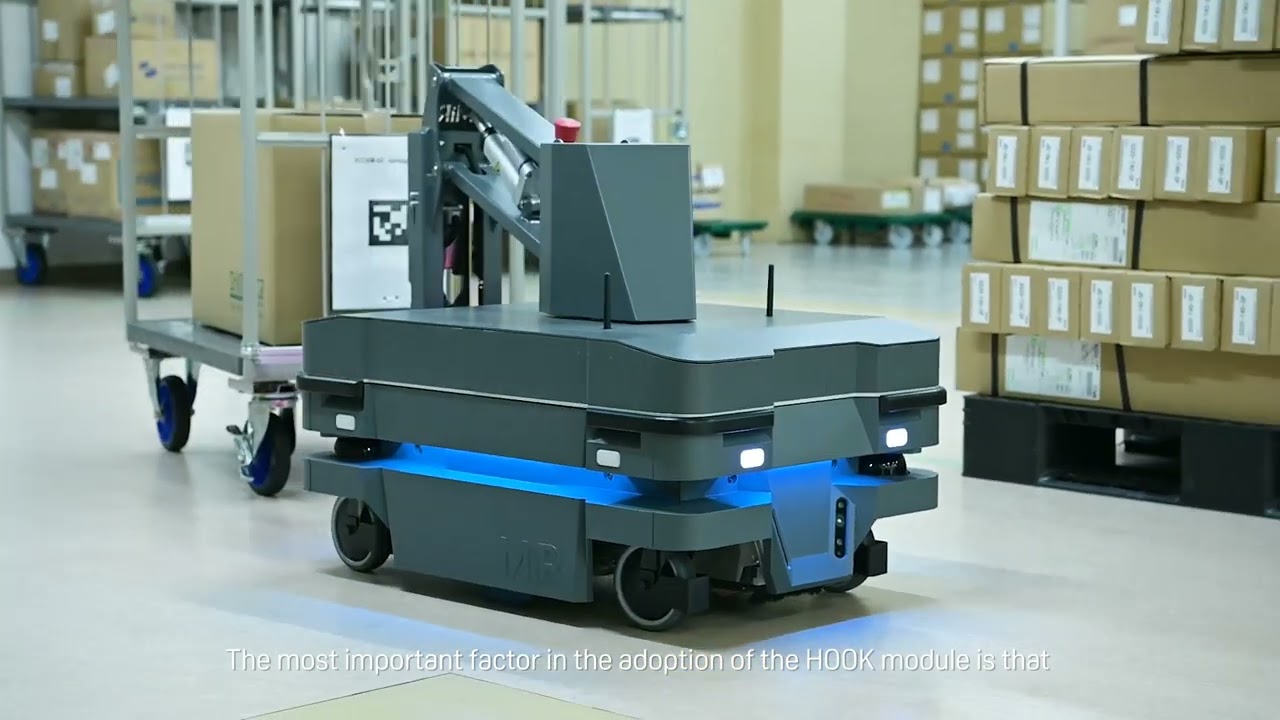
Four MiR250 AMRs were deployed to take over the full container transport cycle: autonomously collecting finished containers from production lines, transporting them to the warehouse, and returning empty containers to the line. The MiR250's autonomous navigation eliminates the safety risks associated with forklift traffic on the production floor. The robots' continuous availability — operating without the scheduling constraints of forklift operators — eliminates the demand-supply mismatch that caused bottlenecks. Mission programming flexibility allows the transport cycle to be adjusted without major infrastructure changes, and the robots' low profile and collaborative safety design enable them to operate alongside human workers without barriers
Megatech required real-time visibility and control over the four-robot fleet — including live location tracking, mission status monitoring, the ability to assign and reprioritize missions dynamically, and rapid incident detection and resolution — integrated into the company's existing operational software environment rather than managed through a separate, standalone robot management system. Achieving this integration without requiring major modifications to Megatech's software infrastructure was a key requirement for the deployment
MTS Tech, MiR's official distributor in Spain, integrated MiR's fleet control software into Megatech's own software platform. This integration gave Megatech's team real-time control of robot locations, active mission status, priority assignment, and incident management from within their existing software environment — without requiring a parallel system or significant IT infrastructure changes. The result is a unified operational picture that allows Megatech to manage the AMR fleet as a native part of their production management workflow
Project Overview
Project Overview
Megatech Industries, a manufacturer of plastic parts for the automotive sector, deployed four MiR250 autonomous mobile robots at its plant in Amurrio, Basque Country, Spain. Published by Mobile Industrial Robots on August 1, 2024, this case study documents how Megatech integrated AMRs into its production floor logistics to replace forklift-based container transport — automating the removal of finished containers from production lines, their transport to the warehouse, and the return of empty containers to the line.
The deployment was implemented with the support of MTS Tech, MiR's official distributor in Spain, who integrated MiR's fleet control software into Megatech's own operational software platform. This integration gave Megatech real-time visibility and control over all four robots from within their existing software environment — including live location tracking, mission monitoring, priority assignment, and incident management.
The Amurrio plant is the first within the Megatech group to deploy MiR robots. Following the results achieved, Megatech is evaluating expansion to its Ourense facility in Spain and subsequently to its operations in the Czech Republic.
System Integrator
MTS Tech — MiR's official distributor in Spain
MTS Tech led the technical integration of the deployment at Megatech's Amurrio plant. Their key contribution was the integration of MiR's fleet control software into Megatech's own operational software platform — enabling the Megatech team to manage all four robots' locations, missions, priorities, and incidents from within their existing software environment without a separate, standalone robot management system. This integration approach was central to the deployment's smooth adoption: it allowed Megatech's operators to manage the AMR fleet as a native part of their production workflow from day one, without requiring parallel systems or retraining on an entirely new interface.
Related Technologies (6)
MiR MC600 Mobile Cobot: Advanced Collaboration in Motion for Intralogistics and Production Workflows
byMiR
Mecalux Autonomous Mobile Robots (AMRs): Flexible and Intelligent Warehouse Transport
byMecalux
Autopicker: AI-Powered Mobile Picking Robot
byBrightpick
Milvus Robotics SEIT: Autonomous Mobile Robots for Material Transport
byMilvus Robotics
KUKA AMRs: Autonomous Mobile Robots for Flexible Production and Logistics
byKUKA
Collaborative AMR System with Vision-Guided Robotic Arm for Part Transfer
byOthers
Related Knowledge Articles (3)
Multi-Robot Orchestration
Intelligent fleet management systems that coordinate multiple autonomous robots to work together efficiently, optimizing task allocation, traffic management, and resource utilization across complex warehouse environments.
Sorting Robot
Sorting Robots use mobile autonomous robots equipped with intelligent vision systems and manipulation capabilities to sort packages, parcels, and items with exceptional flexibility. These systems combine AMR technology with advanced AI to enable dynamic sortation without fixed infrastructure, adapting to changing operational needs and handling diverse item types with human-like dexterity.
Mixed Case Fulfillment Strategy
Mixed case fulfillment is a sophisticated warehouse strategy that handles orders containing multiple different products (SKUs) within the same case, pallet, or shipment. This approach requires advanced automation, intelligent software, and flexible processes to efficiently pick, pack, and ship diverse product combinations while maintaining high accuracy and productivity.