Collaborative Robotic Picking with AI: Mecalux and Siemens Partnership
Quick Facts
Technology Performance Metrics
⭐Key Features
Benefits
Applications
Detailed Information
Technology Overview
Mecalux, in partnership with Siemens, has unveiled a state-of-the-art collaborative robotic picking system designed to revolutionize order fulfillment in warehouses. This solution is built upon the latest artificial intelligence technology, specifically Siemens' SIMATIC Robot Pick AI, a vision software utilizing deep learning algorithms. The system represents a convergence of industrial automation expertise, aiming to address the efficiency and flexibility challenges in modern logistics. It is engineered to handle a diverse array of items autonomously, making it suitable for businesses across various sectors looking to optimize their order processing operations.
The core of the system lies in its AI-driven decision-making capability, which allows a collaborative robot (cobot) to perform picking tasks with high precision and without prior knowledge of the item's 3D model. This technology is the result of a long-standing alliance between Mecalux and Siemens, combining Mecalux's logistics integration know-how with Siemens' industrial automation and AI software strengths.
How It Works
Core Principles
The system operates on the principle of using advanced artificial intelligence as the "brain" for robotic picking. A deep learning algorithm, pre-trained with millions of items, analyzes 3D images in real-time to make millisecond decisions on robust, collision-free picking positions for randomly presented products.
Key Features & Capabilities
The AI-Powered Vision System is the standout feature, enabling the cobot to handle products presented completely arbitrarily without prior 3D modeling. This eliminates significant setup time for new SKUs.
Dual Operational Modes provide flexibility: the system can be deployed as a fully autonomous picking station for high throughput or as a collaborative workstation where the cobot safely interacts with human pickers.
The Integrated Hardware Stack from Siemens, including the S7-1500 PLC and TM-MFP, delivers the necessary computing power to execute complex AI algorithms at the edge, ensuring fast response times and operational reliability.
Advantages & Benefits
The primary advantage is a significant boost in operational efficiency and accuracy. The system can execute up to 1,000 picks per hour around the clock, reducing errors associated with manual picking and increasing overall throughput.
It offers unparalleled handling flexibility. The AI's ability to learn and adapt to millions of items makes the system future-proof and capable of managing the vast SKU variety common in e-commerce and omnichannel retail without constant reprogramming.
The solution enhances workplace safety and ergonomics in its collaborative mode. By taking over repetitive and strenuous picking tasks, it reduces physical strain on workers, allowing them to focus on more complex operations.
Implementation Considerations
Implementing this system requires a significant technological integration effort. Companies must be prepared to deploy and maintain the specific Siemens PLC, AI hardware module, and secure networking infrastructure.
The reliance on advanced AI and deep learning implies that in-house expertise for maintenance and troubleshooting may need to be developed, or a strong partnership with the solution providers (Mecalux/Siemens) must be established.
While designed for flexibility, the initial investment and integration complexity mean the solution is likely best suited for medium to high-volume operations where the efficiency gains can justify the upfront cost and implementation effort.
Use Cases & Applications
Ideal For
This technology is ideal for businesses in e-commerce fulfillment, omnichannel retail, and third-party logistics (3PL) that process a high volume of diverse SKUs and are experiencing labor constraints or seeking to improve picking accuracy and speed.
Performance Metrics
According to the provided information, the system is designed to execute up to 1,000 picks per hour and operate 24/7. The AI algorithm makes picking decisions in milliseconds, ensuring high-speed operation. The key performance gain is in accuracy and autonomy, reducing reliance on manual labor for the picking process itself.
Future Trends
This solution exemplifies the trend of converging Operational Technology (OT) and Information Technology (IT), where AI software directly controls industrial hardware. The partnership also highlights the move towards open, collaborative ecosystems between logistics integrators and industrial automation giants to develop best-in-class, intelligent warehouse solutions.
Conclusion
The collaborative robotic picking system from Mecalux and Siemens represents a significant leap forward in warehouse automation. By leveraging cutting-edge AI for perception and decision-making, it solves the critical challenge of handling variable items at high speed. For companies facing labor shortages, accuracy issues, or the need to handle immense SKU variety, this AI-driven approach offers a compelling path to a more efficient, flexible, and resilient fulfillment operation. Successfully harnessing its potential requires careful planning around integration and a partnership-oriented approach to implementation and support.
Related Projects

Didactic - Normandy France Healthcare Storage Expansion with Pallet Shuttle
Mecalux designed a customized semi-automatic Pallet Shuttle solution for Didactic (Normandy, France) to address 92% storage capacity utilization, delivering 11,000 pallet capacity with FIFO/LIFO functionality for medical device distribution.
HAVI Lisbon Multi-Temperature Logistics Center
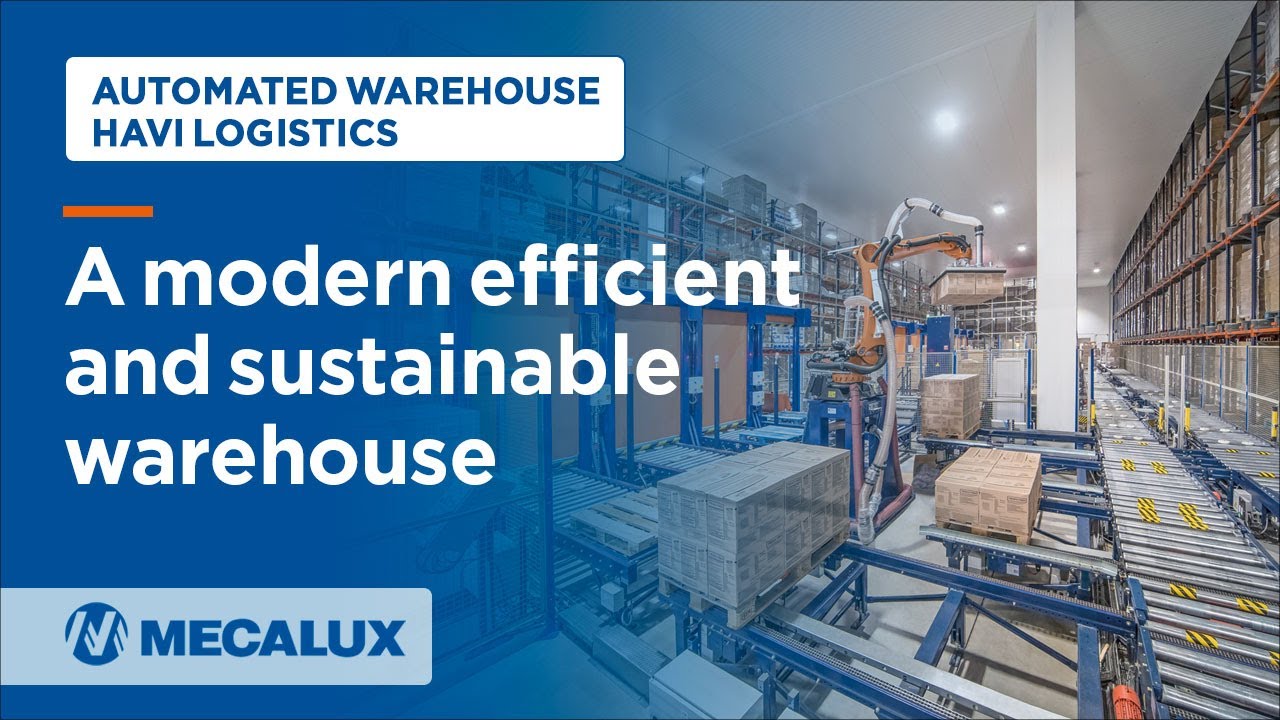
Mecalux delivers a multi-temperature logistics center for HAVI in Lisbon, Portugal, featuring two automated warehouses, Pallet Shuttle systems and Easy WMS integration, supporting daily supply to over 150 restaurants.

Michelin Vitoria Tire Plant Automated Warehouse
Mecalux delivers a 27-meter high automated clad rack warehouse for Michelin's Vitoria tire plant in Spain, supporting three production lines and a planned fourth with 4,600 container capacity and 120 containers per hour throughput.
Related Knowledge
Robotic Case Picking
Advanced robotic case picking systems that combine industrial robotics with intelligent vision systems to automate the handling of full cases and cartons, delivering exceptional speed, precision, and reliability in high-volume distribution operations.
Robotic Piece Picking
Advanced robotic systems that use AI and computer vision to automatically select and pick individual items from diverse inventory, revolutionizing warehouse fulfillment operations with human-like dexterity and intelligence.
Voice Picking Systems
Voice picking systems revolutionize warehouse operations by enabling hands-free, eyes-free order fulfillment through speech recognition technology. Workers receive spoken instructions through wireless headsets and confirm actions verbally, dramatically improving productivity, accuracy, and safety while reducing training time.
Vendor
MecaluxRelated Technologies
Mini FlyPick Robot: Compact High-Speed Sorting AMR
Others

Dark Warehouse: Fully Automated Warehouse Operations
Addverb
Warehouse Slotting Software: WMS-Integrated Location Optimization
Mecalux