Helix System: AI-Powered Robotic Package Sorting
Quick Facts
Technology Performance Metrics
⭐Key Features
Benefits
Applications
Detailed Information
Technology Overview
Figure AI's Helix system represents an emerging frontier in logistics automation, applying advanced artificial intelligence directly to the physical task of package sorting. The system centers on robots powered by a Vision-Language-Action (VLA) model, an integrated AI architecture that combines visual perception, language understanding, and precise physical control. This allows the robots to perceive packages, understand tasks (potentially via natural language instructions), and execute complex manipulations such as flipping items to locate and scan labels. Currently in a pre-launch phase as announced by founder Brett Adcock, this technology aims to address the limitations of traditional automation by introducing a more adaptive, intelligent, and dexterous approach to one of logistics' most labor-intensive processes.
How It Works
Core Principles
The system operates on the principle of embodied AI, where a single, unified neural network (the VLA model) processes visual input, contextual language (possibly task descriptions), and outputs precise robotic actions. The key demonstrated capability is the robot's ability to dynamically manipulate a package—specifically flipping it—to bring a label into view for scanning, all governed by this integrated AI model.
Key Features & Capabilities
Vision-Language-Action (VLA) Model: This is the core technological differentiator. It integrates multiple AI capabilities—seeing, understanding language, and controlling movement—into one model, allowing for more fluid and adaptive task execution compared to systems where these functions are separate.
Sophisticated Package Manipulation: The demonstrated ability to flip packages is a significant capability. It allows the system to handle items where labels are not initially facing the scanner, overcoming a major challenge in automated sortation that typically requires fixed induction orientation or multiple scanners.
Single-Network Control for Complex Tasks: The use of a single neural network to manage the multi-step process of identifying, flipping, and scanning indicates a move towards more general-purpose, learning-based robotic control, as opposed to hard-coded sequences of movements.
Advantages & Benefits
The proposed benefit is a revolution in logistics sorting by introducing a level of robotic dexterity and intelligence that could handle the variability and unpredictability of mixed parcel streams more effectively than current automation. The ability to flip and scan items promises higher first-pass scan rates and reduced need for manual exception handling, potentially increasing overall system throughput and accuracy. It represents a vision for the future of postal sorting where robots can adapt to tasks in a more human-like manner, based on high-level instructions.
Implementation Considerations
As a technology in development and not yet launched, key implementation factors remain undefined. These include the system's throughput speed (items per hour), reliability, and accuracy in a production environment. The cost of implementation for such advanced AI robotics is likely to be substantial. Integrating this technology into existing parcel facility layouts and IT systems (WMS, control systems) would present significant integration challenges. The maintenance and support model for sophisticated AI-driven hardware is also an unknown.
Use Cases & Applications
Ideal For
If successfully commercialized, this technology could be ideal for high-volume parcel and postal sorting centers where package orientation is inconsistent, and where there is a desire to push automation deeper into complex manipulation tasks currently done by humans.
Performance Metrics
No quantitative performance data (e.g., sorts per hour, accuracy rate) is provided in the source, as the system is described as "gearing up for launch." The capabilities described are qualitative and forward-looking. The successful demonstration of the flipping and scanning maneuver is a proof-of-concept milestone.
Future Trends
This technology is itself indicative of a major future trend: the convergence of large-scale AI models (like VLMs) with robotic control to create more adaptive, general-purpose automation for logistics. It points towards a future where robots can understand and execute complex, variable tasks based on natural language commands, reducing the need for highly specialized, fixed engineering for each new application.
Conclusion
Figure AI's Helix system presents a compelling and ambitious vision for the next generation of robotic sorting. By leveraging a unified VLA model, it aims to perform complex package manipulation with a level of intelligence that could significantly advance the state of the art in parcel handling. However, it is crucial to recognize that this is a pre-launch technology. Its real-world impact on logistics will depend entirely on its performance, reliability, and cost when deployed at scale. For the industry, it serves as a strong signal of the direction of travel: towards AI-native, highly dexterous robots that could one day handle the full complexity of logistics work.
Related Knowledge
Robotic Case Picking
Advanced robotic case picking systems that combine industrial robotics with intelligent vision systems to automate the handling of full cases and cartons, delivering exceptional speed, precision, and reliability in high-volume distribution operations.
Robotic Piece Picking
Advanced robotic systems that use AI and computer vision to automatically select and pick individual items from diverse inventory, revolutionizing warehouse fulfillment operations with human-like dexterity and intelligence.
Voice Picking Systems
Voice picking systems revolutionize warehouse operations by enabling hands-free, eyes-free order fulfillment through speech recognition technology. Workers receive spoken instructions through wireless headsets and confirm actions verbally, dramatically improving productivity, accuracy, and safety while reducing training time.
Vendor
Figure AIRelated Technologies
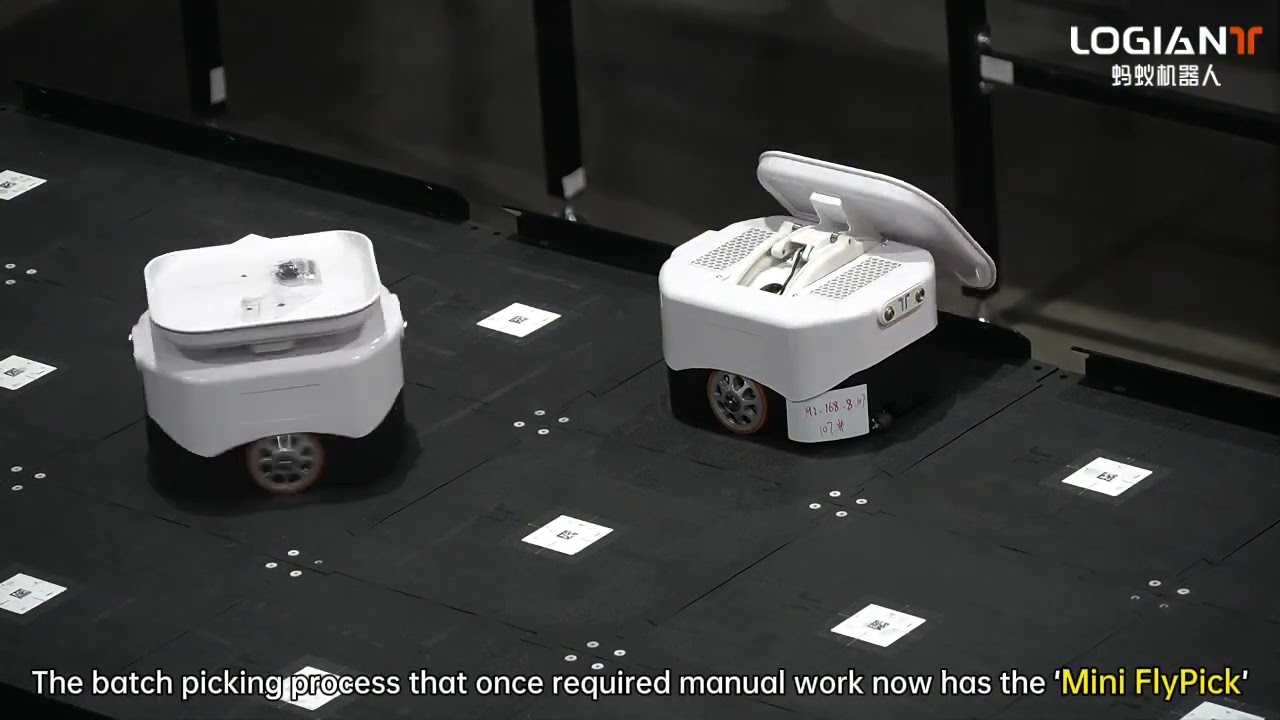
Mini FlyPick Robot: Compact High-Speed Sorting AMR
Others

TiltSort-Bot: Autonomous Mobile Robot (AMR) for Sortation
Conveyco

Dark Warehouse: Fully Automated Warehouse Operations
Addverb