Cobot-AMR Integration: FANUC Cobot & Milvus AMR for Flexible Automation
Quick Facts
Technology Performance Metrics
⭐Key Features
Benefits
Applications
Detailed Information
Technology Overview
Cobot-AMR integration represents a powerful synergy in industrial automation, combining the precise manipulation capabilities of collaborative robots with the intelligent mobility of autonomous mobile robots. Demonstrated by Robsen Robotics and Milvus Robotics, this specific implementation features the FANUC CRX-10iA/L cobot and the Milvus SEIT 300s AMR. The system is designed to create flexible, mobile workcells that can automate complex material handling processes without being constrained to a fixed location. The cobot provides the dexterity and strength for tasks like picking, placing, and operating equipment, while the AMR provides the autonomy to move the entire workcell to different points of need within a facility. This integration is particularly valuable for applications requiring both mobility and precision, such as supplying multiple machines or managing dynamic inventory points.
How It Works
Core Principles
The core principle is Mobile, Vision-Enabled Manipulation. The AMR serves as an intelligent, navigating base that transports the cobot to various workstations or task locations. At each location, the cobot, potentially guided by 3D vision, performs its designated manipulation task. The system operates on a Collaborative Safety principle, with both robots equipped with sensors to allow safe operation in shared human environments.
Key Features & Capabilities
Integrated Mobility and 6-Axis Manipulation is the core capability. The 6-axis cobot provides human-like dexterity to handle parts at various angles, while the AMR provides the freedom to deploy this dexterity anywhere it's needed.
3D Vision-Guided Operation (optional) adds intelligence and flexibility. This allows the cobot to handle items that are not presented in perfectly repeatable positions, adapting to real-world variances in bin picking, machine unloading, or palletizing tasks.
Infrastructure-Less Navigation and Deployment is a key feature of the AMR. The SEIT 300s can operate without requiring installed guides like cables, magnets, or floor markers, making it quick to deploy and easy to reconfigure as needs change.
Inherent Collaborative Safety is designed into both components. Sensors on both robots allow them to operate safely alongside human workers without the need for traditional safety caging, enabling true human-robot collaboration.
Advantages & Benefits
The primary advantage is Unprecedented Flexibility and Reconfigurability. This mobile workcell can be quickly reprogrammed and redeployed to serve different machines or processes, offering a level of adaptability that fixed automation or stationary cobots cannot match.
It significantly Enhances Operational Safety. By design, the system is safe for collaborative environments. The AMR's obstacle detection and the cobot's force-limiting technology allow them to work in direct proximity to people, reducing risks and eliminating barriers.
The integration delivers Remarkable Gains in Efficiency. By automating the entire sequence of travel and manipulation, it streamlines processes like machine tending and part transfer, reducing cycle times, minimizing machine idle time, and freeing human operators for higher-value tasks.
It Improves Inventory Management Accuracy and Speed. In warehouse applications, the mobile system can autonomously perform cycle counts, pick items for orders, or transport goods to packing stations, increasing throughput and reducing errors compared to manual methods.
Implementation Considerations
System Integration and Programming Complexity is a key factor. Successfully merging the control logic of the AMR (navigation, docking) with the cobot (vision, picking paths) requires specialized expertise. Developing robust, error-handling workflows is essential.
End-Effector (EOAT) Design and Payload Management is critical. The gripper or tool must be suited to the specific parts being handled. The combined weight of the cobot, EOAT, and payload must be within the AMR's capacity, and stability during movement must be ensured.
Task and Environment Analysis is necessary. Not all processes are suitable for this type of automation. The tasks should be well-defined, and the facility must have clear navigable pathways for the AMR. Lighting conditions for vision systems may also need assessment.
Conclusion
The integration of a FANUC cobot with a Milvus AMR, as demonstrated by Robsen Robotics, is a compelling solution for automating flexible, multi-point material handling and machine interaction tasks. It is ideally suited for manufacturing environments with multiple machines to tend, dynamic material flow requirements, or for warehouses seeking to automate inventory tasks without fixed infrastructure. The system's strengths are its safety, flexibility, and ability to boost efficiency across disparate processes. Implementing such a solution requires careful planning, a clear understanding of the target applications, and partnership with an integrator capable of handling the combined robotics programming. For businesses looking to add a layer of agile, mobile automation to their operations, this cobot-AMR integration offers a powerful and future-proof path forward.
Related Knowledge
Robotic Case Picking
Advanced robotic case picking systems that combine industrial robotics with intelligent vision systems to automate the handling of full cases and cartons, delivering exceptional speed, precision, and reliability in high-volume distribution operations.
Robotic Piece Picking
Advanced robotic systems that use AI and computer vision to automatically select and pick individual items from diverse inventory, revolutionizing warehouse fulfillment operations with human-like dexterity and intelligence.
Voice Picking Systems
Voice picking systems revolutionize warehouse operations by enabling hands-free, eyes-free order fulfillment through speech recognition technology. Workers receive spoken instructions through wireless headsets and confirm actions verbally, dramatically improving productivity, accuracy, and safety while reducing training time.
Vendor
OthersRelated Technologies
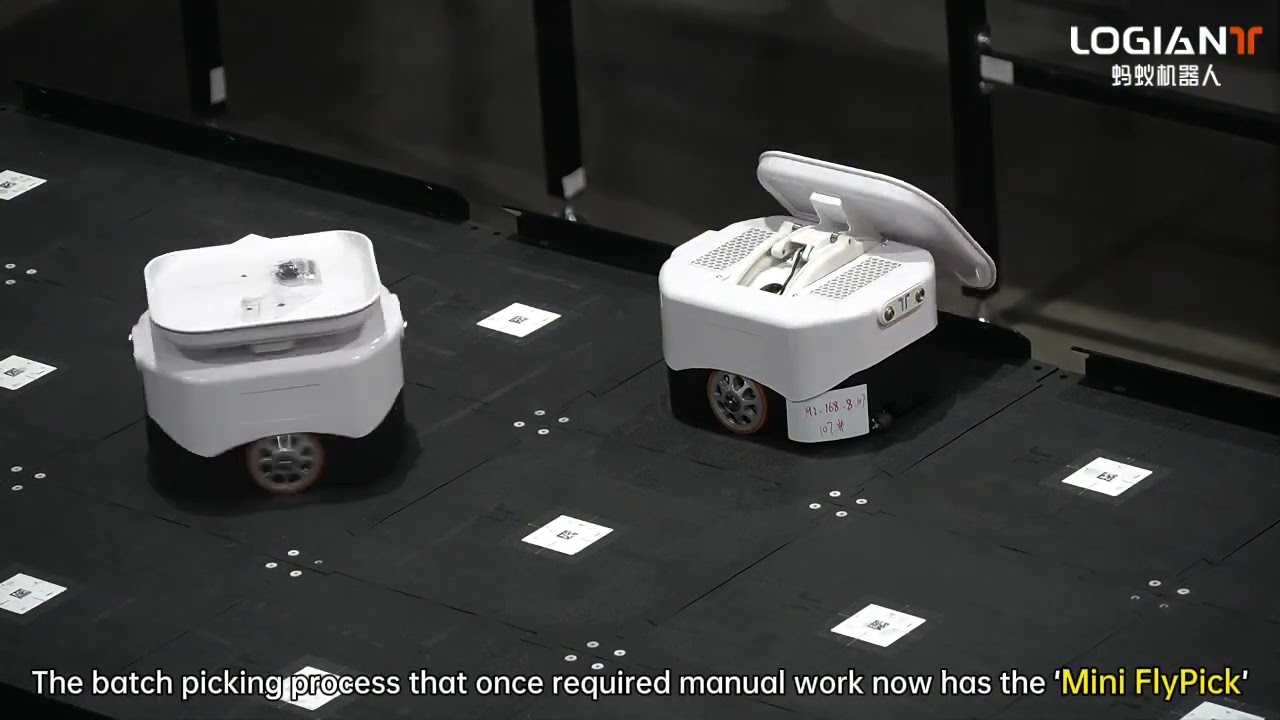
Mini FlyPick Robot: Compact High-Speed Sorting AMR
Others

Split Tray (Bomb Bay) Sorter Compilation: Versatile High-Speed Sortation
Others
Patented Dual Split Tray (Bomb Bay) Sorter with Batch Induction
Others